Studying Math Again Axian Studying Math Again Axian
The results speak for themselves. The latest Trends in International Mathematics and Science Study (TIMSS) and the Programme for International Student Assessment (PISA) accept been released – and, once once again, East Asian countries have ranked the highest in both tests.
Over contempo years, other countries' positions have gone upwards and downwards in the tables but E Asian pedagogy – which includes People's republic of china, Singapore, Taiwan, Southward Korea and Japan – continues to dominate. And the gap betwixt these countries and the residuum of the world is getting wider.
The reasons why East Asian countries are way ahead of the pack every bit far equally education is concerned has long been debated – but information technology essentially seems to come up downwards to the following 4 factors.
1. Civilisation and mindset
There is a high value placed on teaching and a belief that effort rather than innate ability is the fundamental to success. East Asian researchers unremarkably point to this as the most of import factor for this regions high test results.
The positive attribute of this approach to educational activity is that there is an expectation that the vast majority of pupils volition succeed. Learners are non labelled and put into "ability" groups – as they are in England, where this is the norm even in many primary schools. So, in East Asian countries, everyone has the same admission to the curriculum – which means many more pupils are able to get those loftier grades.
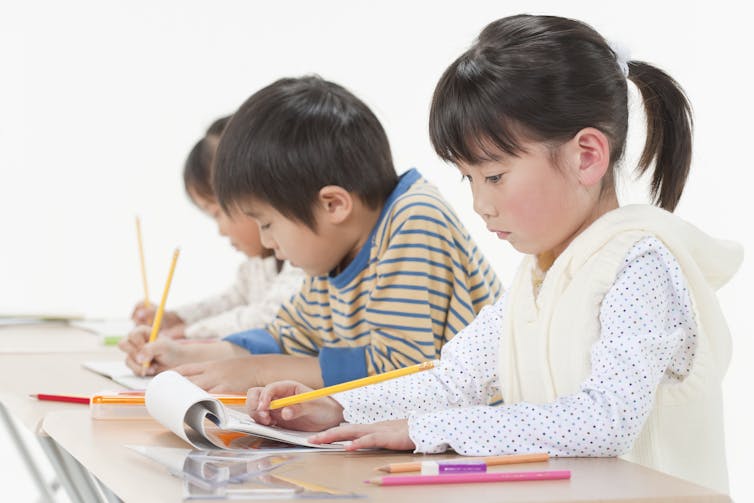
Formal schooling is too supplemented past intensive afterwards-school tuition – at the extreme this can come across children studying well into the dark – and sometimes for up to three hours of extra school in the evening on meridian of two hours of homework a day.
But while this intensive later schoolhouse study can get results, it'southward of import to recognise that in many East Asian countries, educators worry near the quality and influence these "crammers" have on the mental health and well-beingness of children. And many studies looking at pupils' experiences in these schools have reported high levels of boyish stress and a sense of force per unit area to reach – for both the students and their parents.
ii. The quality of teachers
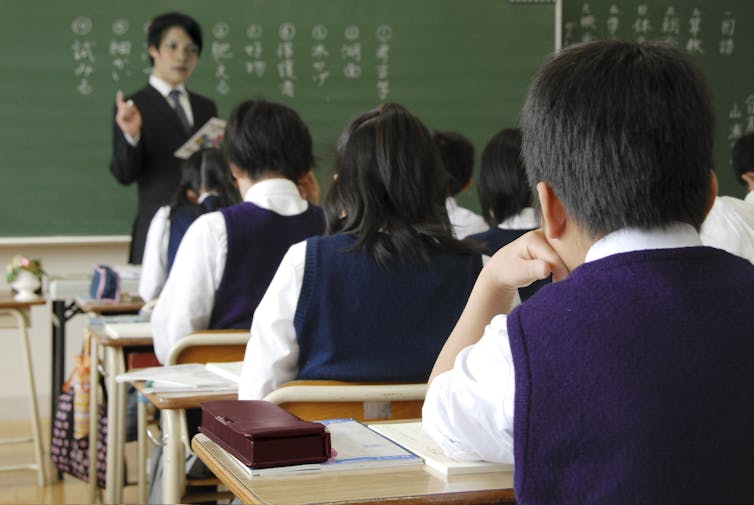
Teaching is a respected profession in East asia, where there is stiff competition for jobs, good conditions of service, longer grooming periods and back up for continuing and all-encompassing professional development.
In Shanghai, teachers have much lower teaching workloads than in England – despite the bigger classes. And they utilise specialist primary mathematics teachers, who teach ii 35-forty minute lessons a day. This gives the teachers time for planning – or the chance to give extra support to pupils that need it – along with time for professional person development in teacher research groups.
In Japan, "lesson report" is embedded in main schools. This involves teachers planning carefully designed lessons, observing each other's education, so drawing out the learning points from these observations. And lesson study also gives teachers time to research and professionally develop together.
3. Using the evidence
Ironic though information technology may be, much of the theoretical basis for East Asian education has been heavily influenced past research and developments in the W. For example, Jerome Bruner's theory of stages of representation which says that learners need hands-on experiences of a concept – then visual representations – as a basis for learning symbolic or linguistic formulations.
This has been translated in Singapore as a focus on concrete, pictorial and abstract models in mathematical learning. For example, this might mean arranging counters in rows of v to learn the five times tabular array, then using pictures of hands that each have 5 digits, before writing multiplication facts in words, and then adding in numerals and the multiplication and equals signs.
4. A collective button
In the 1970s, Singapore's educational outcomes lagged backside the rest of the globe – the transformation of Singaporean education was accomplished through systemic alter at national level that encompassed curriculum development, national textbooks and pre-service and in-service instructor education.
Similarly in Shanghai and Southward Korea educational modify and comeback is planned and directed at a national level. This ways that all schools utilize government canonical curriculum materials, at that place is more consistency about entry qualifications to become a instructor and there is much less diversity of types of schools than in the Great britain.
The success of East Asian education has turned these countries into "reference societies" – ones by which policymakers in the Great britain and elsewhere measure their ain education systems and seek to emulate. Interest in East Asian educational activity in the Great britain has informed the current "mastery arroyo" which is used in chief mathematics. Educational activity for mastery uses methods found in Shanghai and Singapore and has been the footing of many recent research projects – some sponsored past government funding and others promoted by educational charities or commercial organisations.
Just of course, merely fourth dimension will tell if some of the success of these two pedagogy systems can be reproduced in the Uk, while avoiding some of the negative experiences – such as stress and burnout – associated with the East Asian approach to education.
willoughbylextre1939.blogspot.com
Source: https://theconversation.com/pisa-results-four-reasons-why-east-asia-continues-to-top-the-leaderboard-69951
0 Response to "Studying Math Again Axian Studying Math Again Axian"
Post a Comment