List and Review the Principal Controls and Influences That Produce Global Temperature Patterns
As far as nosotros know, Earth is the just planet in our solar system to harbor life. Scientists are however trying to effigy out exactly why that is, but one reason might be that we have plenty of liquid water. The outer planets are very cold, so any water in that location would be locked upwardly in ice. The inner planets are piping hot, then scientists call up most water there would boil abroad.
World, nevertheless, falls right in the heart. It sits in a narrow ring, known to astronomers as the Goldilocks zone, where scientists retrieve liquid water can survive and life might be able to flourish. Like the bowl of porridge in the children'southward story, Earth is not too hot and not too cold. It's just right.
The distance between World and the Dominicus is also a good place to start when information technology comes to understanding Earth's climate. It is the main factor affecting the planet'south average temperature, but it is not the just one. The temperature of the Earth is besides influenced by the composition of the atmosphere, which contains heat-trapping greenhouse gases and other chemicals injected past volcanic eruptions and human activities.
Climate starts with the Sun
Aristotle was the first to attempt to explain weather and climate in his volume Meteorology back in 350 BCE (Figure ane). He believed that in that location were four elements – burn, air, water, and earth – and that they interacted to produce the atmospheric condition phenomena we experience on Earth. Working with these four elements, he was able to explain some things well, but non others. For instance, he correctly wrote that rut (fire) could evaporate water, and that clouds formed when water vapor condensed in the air. Only he too wrote – incorrectly – that thunderbolts barbarous from the sky when it "exhaled" and that shooting stars were burning air.

Many of Aristotle'due south explanations of climate, while creative, were proved wrong past the ii,000 years of scientific discoveries that came afterward him. But he got one major point correct: The Dominicus is the most of import cistron in driving climate. Or as Aristotle put it, "The Sun'due south motion alone is sufficient to account for the origin of terrestrial warmth and heat" (Meteorology, Book 1, Office 3). We would improve this at present to say that the Sun's energy, rather than its motion, accounts for warmth and heat.
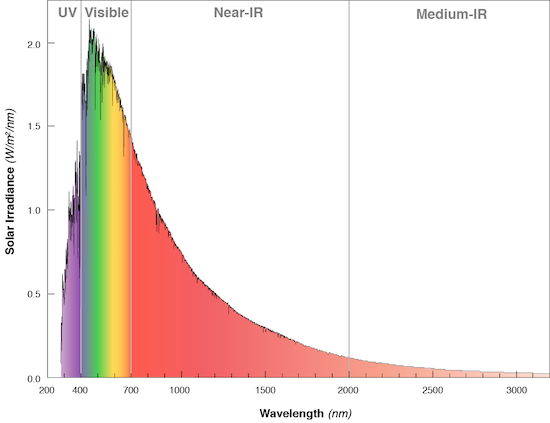
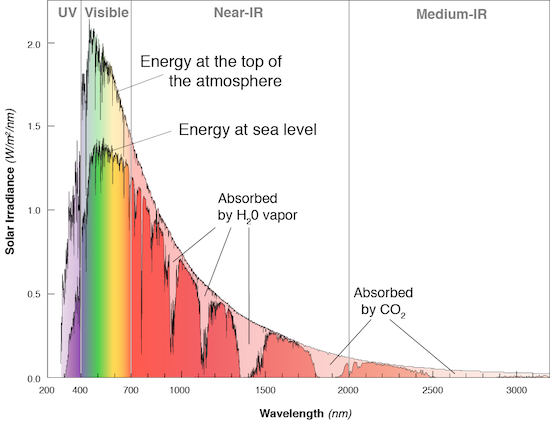
Indeed, the Sun is the primary source of energy at Earth's surface. This free energy is produced past nuclear fusion in the Dominicus'southward core, a procedure that heats the core to approximately fifteen 1000000 degrees Celsius. The heat created inside the Sun so makes its way through the star's interior to the surface, where the temperature is a mere 5,800° C. From the surface, this free energy radiates into space in the class of visible light and other kinds of energy along the electromagnetic spectrum (run across Figure ii for the consummate solar emission spectrum). You can acquire more about calorie-free and electromagnetism in our module on Light and Electromagnetism.
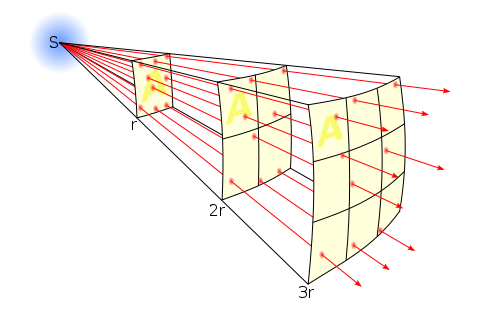
As this energy travels 150 million km beyond the solar system to our planet, its intensity decreases. To empathise why, imagine a single light seedling called-for in a large empty room. When you are right next to the lightbulb, it is very brilliant: You could read a book. Simply equally you move farther away from the seedling in any direction, it becomes harder and harder to read because less low-cal reaches your location.
In fact, the amount of lite that makes it from the bulb to your eyeball decreases faster than the rate at which y'all move abroad from the bulb, and here's why. When you stand up close to the bulb, the energy that reaches yous is spread effectually a sphere whose radius is the distance between you and seedling. When yous motility twice as far away, the light reaching you now is spread around a sphere with twice the radius. Simply because the surface expanse of a sphere equals 4πr 2, that low-cal is now spread over an area iv times every bit big (meet Effigy 3 for an illustration of this concept).
As a effect, planets closer to the Lord's day receive much more solar radiations than planets farther out in the solar organisation. The World receives 342 Watts per meter squared or Due west/one thousand2; this received energy from solar radiation is called insolation. That's virtually twice as much insolation as Mars and one-half as much every bit Venus (see Effigy iv).
Yet, Earth doesn't absorb all of the solar radiation that comes our way. About 30% of information technology reflects off of light-colored surfaces, like clouds, snow, ice, and sandy deserts. The fraction of reflected light is known as albedo, and it also varies between planets (see Effigy 4). Mercury, which has virtually no temper or ice, reflects only 10% of incoming radiation, while Venus, which is cloaked in a thick haze of carbon dioxide, reflects virtually 75%.
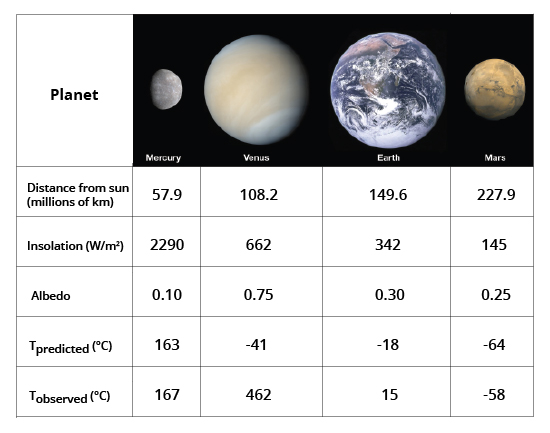
If incoming sunlight and albedo were the simply factors involved, scientists accept calculated that the boilerplate temperature of the Earth would be -18° C (approximately 0° F), shown as Tpredicted (or predicted temperature) in Figure 4. But conspicuously that's not the case – that's much too cold to maintain the liquid water that makes upwards World's vast oceans. In fact, the observed boilerplate temperature (Tobserved in Figure 4) is effectually 15° C (59° F), well above the freezing temperature of water.
Venus has an fifty-fifty larger difference between the predicted and observed average temperature, while the predicted and observed temperatures for Mercury and Mars are close to equal (Effigy four). Therefore, another forces must influence Earth's climate besides just the Sun. And these forces must be greater on Venus and near not-existent on Mars and Mercury.
Comprehension Checkpoint
Energy from solar radiations is chosen
The greenhouse upshot
The first person to recognize the discrepancy between the temperature of Earth and the corporeality of energy received from the Sun was a French mathematician named Joseph Fourier. He had been studying heat period in the ground, and concluded that although the interior of the planet was hot, it did not supply much energy to the surface. By and large, the Sun provided energy for the surface, but that was not enough to explicate observed temperatures. In improver, he proposed that the atmosphere might help warm our planet (Fourier, 1827).
Notwithstanding, scientists hadn't notwithstanding invented the tools that would permit him to exam his idea quantitatively. So, instead, he used the analogy of a simple device called a heliothermometer, or a "hot box," to explain how the process might piece of work. A hot box consisted of an insulated box, painted black on the inside, with a glass lid that enclosed a thermometer (the solar ovens of today are basically modified heliothermometers).
The device was invented by the Swiss physicist Horace de Saussure, who wanted to understand why temperatures are libation on mountaintops than in valleys. De Saussure thought he could use the temperature of the thermometer to mensurate solar insolation, which he thought might decrease with altitude, resulting in colder temperatures. However, his experiments revealed that solar radiation really increases at higher elevations, while air temperature decreases. (Learn the correct caption for the change in temperature at higher meridian in our module The Composition of Earth'southward Atmosphere).
Only Fourier used the hot box for another kind of experiment – a thought experiment. He knew that about solar radiation, which peaks in the visible part of the electromagnetic spectrum (meet Figure two), passed through the pane of drinking glass unimpeded. The black walls of the box then captivated this energy and heated up. The walls of the box then emitted long-wavelength infrared energy (seen to the right of the visible spectrum in Figure ii), which was known in Fourier's 24-hour interval as "night heat" because it is invisible to the man centre.
In this process, the hot box converted energy in the visible function of the spectrum to infrared energy. But Fourier also knew that glass is mostly opaque to infrared energy – information technology blocks information technology the same style a brick wall blocks visible light. So as sunlight connected to enter the box and the walls continued to warm, heat built up inside and increased the temperature. He thought the same thing might happen in the atmosphere if information technology, besides, was transparent to visible calorie-free but blocked Earth'south outgoing infrared radiations.
This idea would later exist called the "greenhouse effect," because the glass walls of greenhouses as well warm the air inside them. All the same, both greenhouses and de Saussure's hot box are imperfect models for how greenhouse gases actually behave in Earth'south atmosphere. That's because they are both enclosed spaces that physically trap warm air, and this accounts for much of the observed warming (in the same way that a car heats up on a hot 24-hour interval, even though information technology doesn't take a transparent roof). In reality, World'southward atmosphere absorbs approachable infrared radiation, heats up, and radiates it in all directions, including back down toward the surface (more than on this beneath).
Still, past conducting this thought experiment, Fourier identified two important features of the greenhouse consequence. The beginning is that the atmosphere is basically transparent to visible calorie-free only absorbs infrared free energy. The second is that visible light tin can be transformed into infrared energy past being absorbed and re-emitted at Earth's surface.
Comprehension Checkpoint
Solar insolation ____ at higher altitudes.
Greenhouse gases
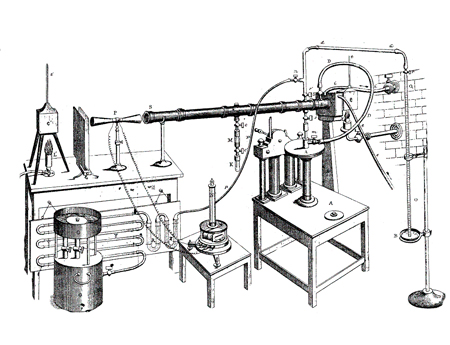
Fourier's ideas sounded promising, but no ane could actually test them until 1859, more than than 30 years later on Fourier published his ideas, when an English physicist named John Tyndall set out to determine whether the atmosphere actually does blot infrared radiation. Over the grade of two years, he devised an musical instrument that would permit him measure how much free energy was lost subsequently passing through a 1.2-meter-long tube of air (his instrument is shown in Figure 5).
To seal the tube, he placed slabs of stone salt on both ends. Why rock salt? Because unlike drinking glass, salt is transparent to infrared radiation. He and so gear up a pot of boiling water or hot oil at one cease, which produced a source of infrared radiation with a constant temperature, and thus, a abiding wavelength. He measured how much energy came out the other end by detecting very small changes in temperature using a homemade sensor.
When Tyndall filled the tube with dry air, pure oxygen, or pure nitrogen, he did not observe any alter in the amount of energy that passed through the tube. He tried every gas he could get his easily on, and when he finally added ethylene gas (C2H4) – the gas emitted by fruit when it ripens – he saw that much of the radiation was absorbed between the entrance and exit of the tube. This surprised him. He wrote:
The gas was invisible, nix was seen in the air, only the needle [of the detector] immediately alleged its presence… Those who like myself have been taught to regard transparent gases as almost perfectly diathermanous [permeable to oestrus], will probably share the astonishment with which I witnessed the foregoing effect. (Tyndall, 1861)
He continued with his experiments and documented the absorption of infrared energy when the tube was filled with several other chemicals. It turns out that Tyndall had merely discovered greenhouse gases, the gases that absorb infrared radiation in the temper, refining Fourier'southward hypothesis. We now know that the well-nigh important greenhouse gases are h2o vapor, carbon dioxide, methane, and nitrous oxide, all of which absorb free energy at specific wavelengths in the infrared region, shown in in Figure 6.
When he recognized how powerful these greenhouse gases were, Tyndall speculated that even small changes in the concentration of these gases in the atmosphere could exert a potent influence on Earth's climate:
It is not, therefore, necessary to assume alterations in the density and pinnacle of the atmosphere to business relationship for unlike amounts of rut beingness preserved to the Earth at different times; a slight change in its variable constituents would suffice for this. Such changes in fact may have produced all the mutations of climate which the researches of geologists reveal.
Tyndall turned out to be correct. Modest changes in the concentrations of greenhouse gases do alter climate dramatically. However, it'south important to note that there is a key difference betwixt water vapor and the residual of the greenhouse gases.
Biological and physical processes (including human activity) tin produce and eat greenhouse gases similar carbon dioxide, methane, and nitrous oxide, changing their concentrations in the atmosphere and thus causing climate to change. In dissimilarity, the concentration of water vapor in the temper is controlled by the temperature of the planet: When the atmosphere is warmer, information technology tin can (and does) hold more water vapor, and the contrary is the case when it'due south cold. Thus, even though water vapor is the nigh powerful greenhouse gas, information technology does non cause climate changes. Information technology responds to these changes and amplifies them.
Comprehension Checkpoint
Gases de efecto invernadero ____ Radiación infrarroja en la atmósfera.
Other atmospheric components
Compared to gases similar nitrogen and oxygen, which together make up 99% of the atmosphere, greenhouse gases brand up simply a tiny fraction of air (see our module Composition of Earth'due south Temper for more than information). Today, the concentration of carbon dioxide in the atmosphere is almost 400 parts per meg and the concentration of nitrous oxide is nigh 325 parts per billion! In improver to greenhouse gases, other small-scale components of the atmosphere also affect climate, like aerosols.
Aerosols are tiny particles that float in the air, and they usually have the opposite effect of greenhouse gases: as the concentration of aerosols increases, surface temperatures subtract. That's considering aerosols generally reverberate incoming sunlight, increasing Earth's albedo. However, in some cases, dark-colored particles, similar soot, tin absorb light more efficiently, and pb to warming.
Aerosols can include dust and microscopic droplets of liquids similar sulfuric acrid, which go ejected into the temper later on large volcanic eruptions. Such eruptions demonstrate the outcome of aerosols on climate; global average temperatures dipped briefly after each of the major eruptions of the 20th century, every bit shown in Figure 7, including the 1991 eruption of Mount Pinatubo.
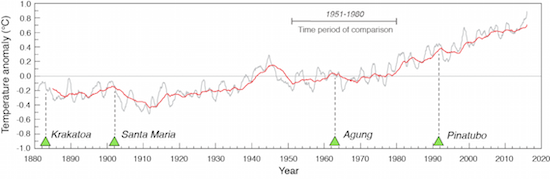
Nonetheless, aerosols just remain in the air for a few years, and are not evenly distributed like greenhouse gases. There are ever some floating around in the atmosphere, because natural processes continually produce them. But bursts of aerosols from big eruptions merely affect climate temporarily as shown in Figure vii, where you lot tin can see that temperature drops sharply subsequently very large volcanic eruptions and so returns to the previous boilerplate only a few years subsequently.
The first climate model
One way to determine if you have taken into account all of the factors that influence a system is to build a model that combines them and come across if information technology matches observations (see our module Modeling in Scientific Research for more than information). The first scientist to take Fourier and Tyndall's results and put them into a quantitative climate model was the Swedish chemist Svante Arrhenius, who is maybe best known for his work on the rates of chemical reactions.
Arrhenius set out to account for all the energy coming into and leaving the World arrangement – a kind of free energy budget (Arrhenius, 1896). That required tallying up all the sources of energy, the ways energy could be lost (known equally free energy sinks) and the ways energy could be transferred (known as energy fluxes). Arrhenius did non include an illustration in his 1896 paper, but it is useful here to put his ideas into a diagram, shown in Effigy 8.
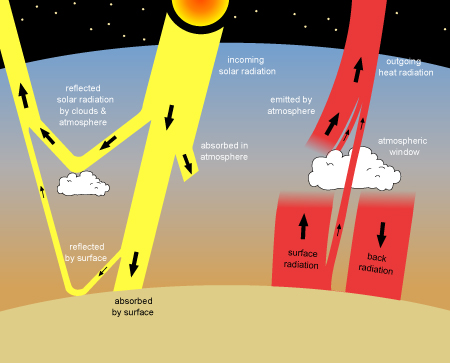
On the incoming side of Arrhenius' equation was solar radiation (thin blackness arrows in Figure eight). On the outgoing side was the long-moving ridge infrared radiation emitted by the Earth'due south surface (thick red pointer), plus reflected sunlight (thin gray arrows). However, Arrhenius knew that he likewise had to account for greenhouse gases in the atmosphere, which Tyndall had shown interfered with outgoing radiation.
Arrhenius reasoned that if the atmosphere was absorbing infrared radiations, information technology too was heating upward. Thus, he added another level of complication to his model: an atmosphere that could absorb and radiate estrus just like Earth's surface. For simplicity, he treated the whole atmosphere equally i layer. The atmosphere captivated outgoing radiations emitted by the surface (thick red arrow), and so emitted its own radiation both upwards to space and back down to Earth (thin red arrows).
This was an important realization, because it showed that the temper didn't block outgoing radiation as Fourier had proposed. Information technology captivated it. And so, like the hotbox, information technology heated upwardly and emitted infrared energy. The atmosphere emits this free energy in all directions, including back toward the earth. This flux of energy from the atmosphere to the surface represents another important source of heat to Earth's surface, and information technology explains the existent mechanism behind the greenhouse issue.
Comprehension Checkpoint
Arrhenius proposed that the atmosphere of Earth ______outgoing radiation.
The Goldilocks zone and the search for extraterrestrial life
In 2009, NASA launched the Kepler Infinite Telescope with the goal of finding other potentially habitable planets in our milky way. So far, scientists have found and confirmed more than one,000 and then-called exoplanets. Of these, twelve lie within the Goldilocks zone, where water tin exist as a liquid.
Nosotros don't yet know whether they might harbor life – at the moment, they are just faraway objects whose very presence is barely detectable. But, from what we've learned about our own solar system, we know that it's not enough to know how far these exoplanets sit down from their stars. World's greenhouse effect helps brand the planet more habitable. But on Venus, carbon dioxide makes up 96% of the atmosphere, and the greenhouse effect heats the planet 500 degrees Celsius to a higher place its predicted temperature (see Figure 4), making it hotter than Mercury. Therefore, while scientists have started the search for extraterrestrial life by looking for planets that are the correct distance from their star to have host liquid water, they must consider the composition of the atmospheres of those planets and use their understanding of the greenhouse upshot that researchers discovered here on World.
Summary
Based on how much sunlight hits Globe versus how much is reflected, Earth's average temperature should exist well beneath freezing. Fortunately, there are other factors that affect the planet's temperature. This module explores the furnishings of those factors, including distance from the lord's day, aerosol particles floating in the air, and greenhouse gases. Topics introduced include insolation and albedo. As well explored is how a planet'due south climate can be modeled past taking account of energy in, free energy lost, and energy transferred.
Fundamental Concepts
-
The Sun is the primary source of energy that influences any planet's temperature, including World. The amount of energy received from the Sunday is called insolation; the ratio reflected is called the albedo.
-
The composition of a planet's atmosphere also influences its temperature, especially the concentration of greenhouse gases present.
-
The Globe converts solar radiation in the visible spectrum to infrared radiation, which it emits; greenhouse gases absorb infrared radiations and warm the atmosphere.
-
Aerosols usually act to cool the Earth on relatively brusk timescales.
-
Any planet's climate, including Globe'due south, can be modeled very simply by calculating fluxes of energy.
willoughbylextre1939.blogspot.com
Source: https://www.visionlearning.com/en/library/Earth-Science/6/Factors-that-Control-Earths-Temperature/234
0 Response to "List and Review the Principal Controls and Influences That Produce Global Temperature Patterns"
Post a Comment